

Construction Financing in the Current Environment: What's Changed, What Hasn't
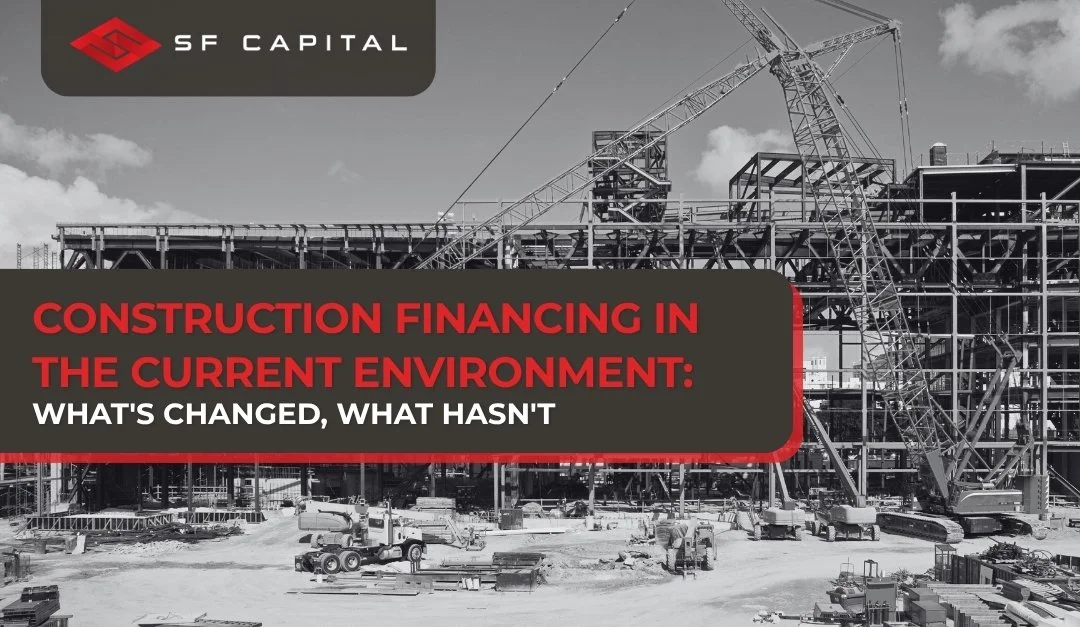
Construction financing has always been the most sensitive corner of commercial real estate lending to shifts in rates and underwriting discipline, and 2026 has made that sensitivity visible in the data itself. Multifamily starts fell 40.2% in May to a 295,000-unit annualized pace, down 14.2% year over year, according to Census Bureau data released through NAHB. One month later, they rebounded 76.2% to a 532,000-unit pace, up 17.2% year over year. That kind of whiplash isn't a market finding a new normal. It's a market where the go or no-go decision on a project is unusually close to the margin, and small shifts in financing costs are tipping projects one direction or the other from month to month.
What's Actually Changed
Construction lending has not disappeared, but it has become materially more selective than it was two years ago. Lenders across bank, life company, and debt fund categories are applying a more consistent flight-to-quality standard: strong, experienced sponsors with a track record of completed comparable projects get access to capital on reasonable terms, while first-time or thinly capitalized developers face a much narrower set of options. Equity requirements have moved higher across the board, and interest reserves are being sized more conservatively to account for the possibility of a slower lease-up than pro forma assumes.
The property types where construction capital is most available track closely with where operating fundamentals are strongest. Industrial and well-located multifamily continue to attract construction lenders willing to compete on terms. Office construction, outside of build-to-suit and highly specific situations, has become close to unavailable outside a handful of markets.
What Hasn't Changed
The fundamentals of a financeable construction deal haven't moved. Lenders still want to see a credible, conservatively underwritten pro forma, a realistic construction budget with appropriate contingency, an experienced general contractor, and a clear, defensible path to either stabilization and permanent takeout or a sale. What has changed is the margin for error in each of those categories. A pro forma that was aggressive-but-defensible in 2021 reads as unrealistic in 2026's underwriting environment, and lenders are less willing to extend the benefit of the doubt on any single weak point in the package.
A Regional Note
On a year-to-date basis, the Midwest was the only region in the country posting growth in single-family permits, even as national permit activity was roughly flat. That regional resilience matters for construction lenders evaluating where to deploy capital. A market with steady, if modest, permit growth signals more predictable absorption than markets seeing sharper swings, and that predictability is exactly what construction lenders are pricing for right now.
What Developers Should Do Differently
Bringing a construction deal to a lender in this environment means over-preparing relative to what worked in past cycles. That means a budget with real contingency built in rather than a bare-minimum number, a sponsor bio that leads with completed, comparable projects rather than aspirational scale, and a takeout strategy that doesn't depend on rates improving between groundbreaking and completion. Developers who build their underwriting around today's financing costs, and treat any future rate relief as upside rather than a requirement, are the ones getting deals funded.
How SF Capital Can Help
SF Capital places construction and bridge-to-permanent financing across the Midwest and helps sponsors package deals to meet today's higher underwriting bar before they go to market. If you have a development project you're preparing to finance, contact the SF Capital team.
