

Why Institutional Capital Is Chasing Self-Storage and Data Centers.
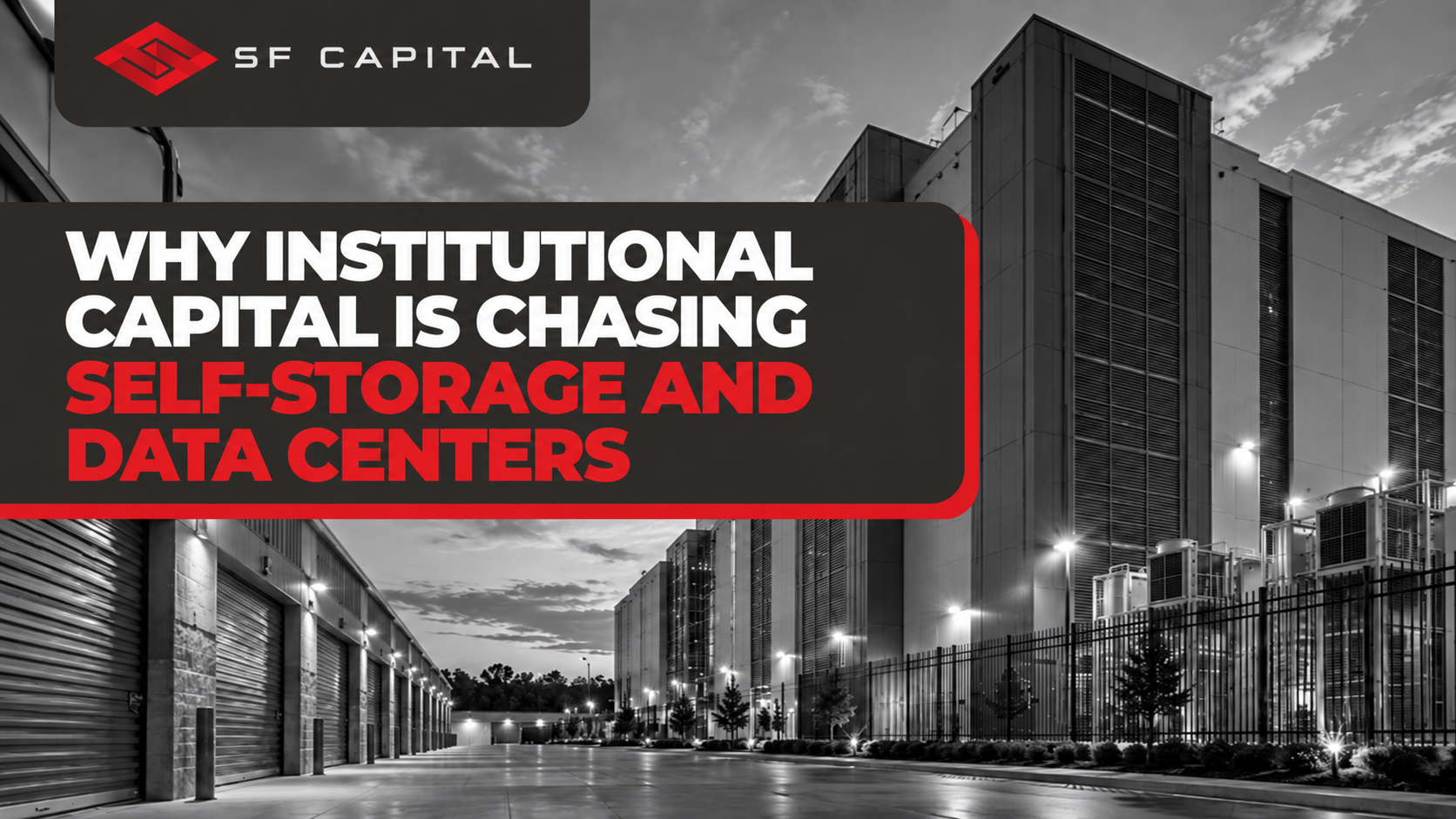
Every cycle has a handful of asset classes that quietly go from niche to core while everyone's attention is on office and retail. This cycle, that's self-storage and data centers, two very different property types pulling in institutional capital for surprisingly similar reasons: durable, less cyclical income and a buyer pool that keeps growing faster than supply can meet it.
Self-Storage: Consolidation Is Accelerating
Self-storage cap rates are expected to stabilize near 5.5% to 5.8% through 2026, with gradual compression toward 5.0% to 5.5% possible by 2028 as fundamentals continue to improve, according to recent market research. Investor appetite backs that up directly: 65% of respondents in a recent investor survey indicated intent to be net buyers of self-storage this year. Institutional and REIT ownership of the sector, currently around 39% of total inventory, could reach 45% to 50% by 2031 as scale economics in technology-driven pricing and operations give larger owners an edge independent operators can't easily replicate.
For an independent self-storage owner, that consolidation trend is a real signal about where sale and recapitalization interest is headed, and it's accelerating rather than leveling off.
Data Centers: Power Is the Constraint, Not Demand
Data centers are on an entirely different trajectory, driven by the AI infrastructure buildout. Hyperscale operators collectively announced more than $300 billion in data center capital expenditure across 2024 and 2025, absorbing available shovel-ready sites with secured utility power about as fast as they could be identified. Cap rates for stabilized Tier 1 data center assets now range from roughly 4.25% to 6.25%, with the tightest hyperscale-leased facilities compressing further still. The constraint on new supply isn't demand, it's utility interconnection timelines, which commonly run 18 to 36 months, meaning the development pipeline structurally cannot respond quickly to how fast demand has grown.
What These Two Sectors Have in Common
On the surface, a climate-controlled storage unit and a hyperscale server farm have almost nothing in common. Underneath, the appeal to institutional capital is nearly identical: both offer income streams that are far less exposed to the kind of tenant rollover, lease-driven volatility, and e-commerce disruption that have weighed on office and traditional retail. Self-storage benefits from low capital intensity, minimal tenant improvement costs, and demand that holds up across economic cycles. Data centers benefit from long-term leases to investment-grade tenants and a structural supply constraint that shows no signs of easing in the near term. Capital that used to default to office and retail as core holdings is increasingly finding both of these sectors a more durable place to park long-duration money.
The Midwest Opportunity
Both sectors have a growing Midwest story. Data center developers have been actively scouting Midwest markets for available power capacity and land cost advantages relative to more saturated coastal data center hubs, and several Midwest utilities have meaningful interconnection capacity that's increasingly scarce elsewhere. Self-storage in the Midwest has benefited from steady, less volatile demand growth compared to some of the faster-boom, faster-bust Sun Belt markets, which is exactly the kind of profile institutional buyers are prioritizing as they underwrite for durability rather than peak growth.
What This Means for Financing
For owners and developers in either sector, the financing conversation has genuinely improved. Lenders, including banks, life companies, and debt funds, have grown more comfortable underwriting both asset classes as institutional transaction volume and operating data have matured. That's a meaningful shift from five years ago, when both sectors were often treated as specialty asset classes requiring a narrower set of lenders willing to underwrite them.
How SF Capital Can Help
SF Capital places financing across the full range of property types, including the niche and emerging asset classes that are attracting real institutional capital right now. If you own or are developing a self-storage or data center asset, contact the SF Capital team to talk through your financing options.
